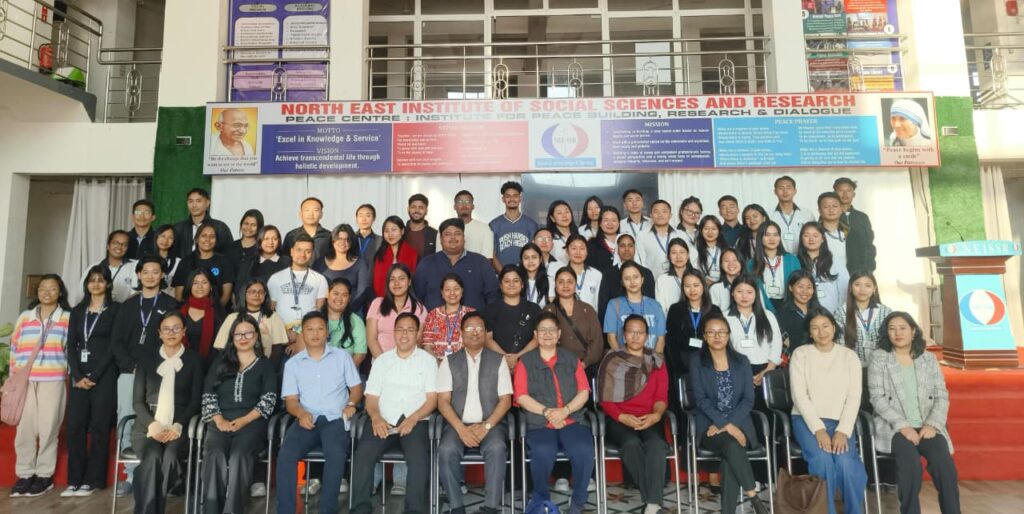
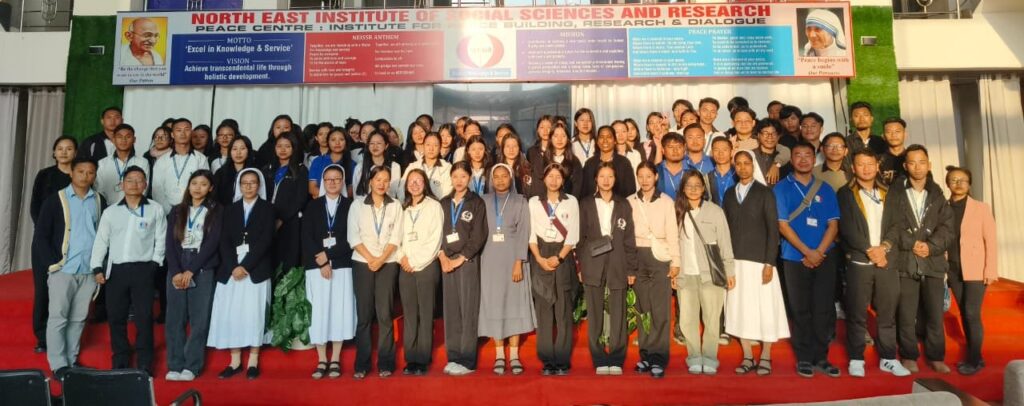
Master of Social Work (MSW) trainees from the Department of Social Work, Tezpur University, Assam, visited the North East Institute of Social Sciences and Research (NEISSR), CHumoukedima, Nagaland on 16 February 2026 as part of their rural camp. The visit aimed to promote academic exchange, professional interaction, and inter-institutional collaboration among social work trainees in the North East region.
The visiting delegation was led by Dr. Samhita Barooah, Assistant Professor, Department of Social Work, Tezpur University. The trainees were formally received and participated in an interactive session with MSW trainees of NEISSR. During the interaction, trainees from both institutions shared experiences from their fieldwork, discussed community engagement strategies, and reflected on contemporary issues in social work practice. An institutional overview of NEISSR, its academic programmes, and fieldwork model was presented by Dr. Toli H. Kiba, Assistant Professor, NEISSR, along with Dr. Fr. C. P. Anto, Principal, NEISSR. The talks highlighted the institute’s commitment to practice-oriented training and collaborative academic engagement.
Both institutions expressed a shared interest in fostering future partnerships through joint academic initiatives, exposure visits, research collaboration, and student exchange programmes. The visit concluded with a collective call to strengthen institutional linkages and promote sustained cooperation for the advancement of social work education and community-based practice in the region.
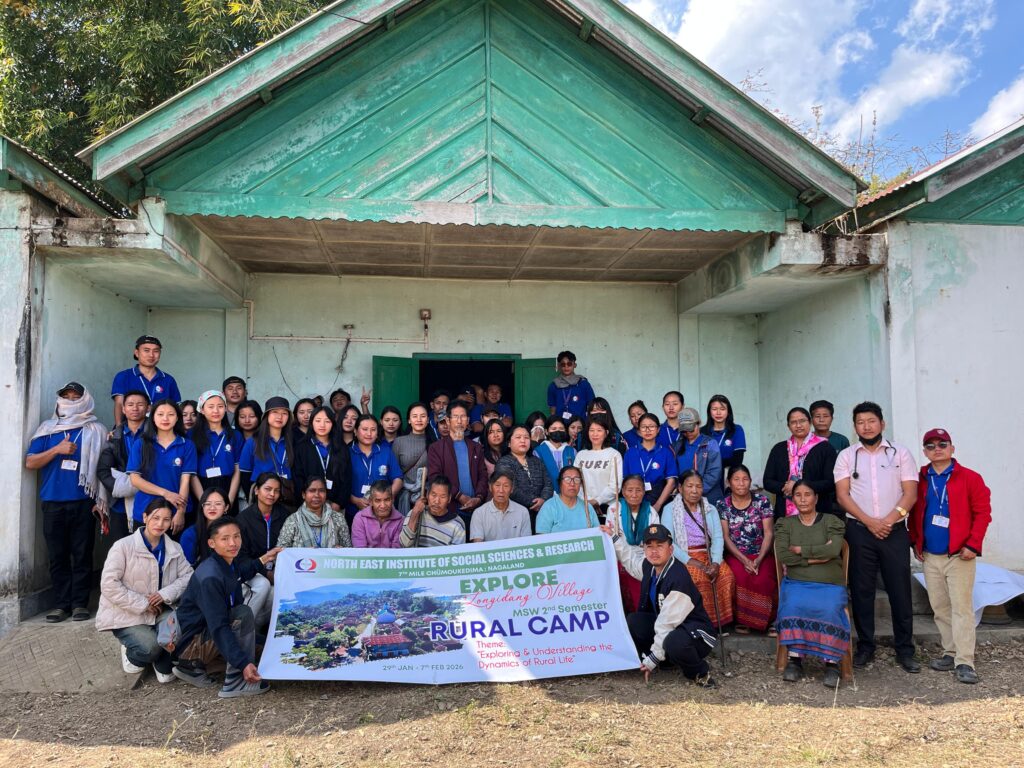
The Master of Social Work (MSW) second semester trainees of the North East Institute of Social Sciences and Research (NEISSR), Chümoukedima, successfully organized and conducted a ten-day Rural Camp at N. Longidang Village under Wokha District, Nagaland, from 29 January to 7 February 2026. The Rural Camp forms an integral component of the MSW curriculum and is designed to bridge classroom learning with real-life community practice through direct field exposure.
The primary objective of the camp was to familiarize students with rural life, community structures, local governance systems, and participatory development processes. Through sustained interaction with the villagers, the trainees gained firsthand understanding of grassroots realities while applying social work theories and methods in a practical setting. Participatory Rural Appraisal (PRA) techniques were extensively used to assess the social, economic, and environmental conditions of the village.
During the camp, the trainees actively engaged in various PRA tools, household surveys, transect walks, and community analysis using locally available materials. These activities enabled the trainees to identify community needs, resources, and challenges in collaboration with the villagers. The camp also emphasized environmental responsibility through cleanliness drives, installation of bamboo dustbins, and awareness programmes on proper waste management practices.
Several community-oriented programmes were organized as part of the camp. A Health Camp and the observance of World Cancer Day were conducted in collaboration with the Village Primary Health Centre, providing basic health check-ups and health awareness for the villagers. Social awareness was further promoted through street plays on themes such as parenting styles and unemployment, encouraging dialogue and reflection within the community. Sports and recreational activities were organized for children and youth, fostering interaction, cooperation, and community bonding.
Cultural and social exchange formed an important component of the camp experience. The trainees participated in church services and youth fellowship programmes, and organized a cultural evening showcasing performances that strengthened mutual understanding and appreciation between the students and the local community. Interactive sessions with village leaders provided valuable insights into local governance, leadership structures, and development priorities.
The camp concluded with a thanksgiving and valedictory programme, expressing gratitude to the village authorities and residents for their warm hospitality, cooperation, and support throughout the duration of the camp. A final evaluation session reflected on the learning outcomes and overall experiences gained during the rural exposure.
The Rural Camp at N. Longidang Village proved to be a meaningful and enriching experience for the MSW trainees. It significantly contributed to the development of the trainees’ professional competencies, leadership qualities, teamwork, and sense of social responsibility. The camp successfully fulfilled its objectives by fostering experiential learning and strengthening the trainees’ commitment to community-centered and participatory social work practice.
North East Institute of Social Sciences and Research (NEISSR), Chümoukedima, organized a series of academic study tours for the Master of Social Work (MSW) 4th Semester trainees of Peace and Conflict Transformation Studies (PCTS), Community Development (CD), Youth Development (YD), and Social Entrepreneurship Development (SED) specializations during January–February 2026. These study tours formed an integral component of the MSW curriculum and aimed to enhance experiential learning, professional exposure, and field-based competencies among trainees through direct engagement with social development institutions and communities.
The PCTS study tour was conducted from 26th January to 3rd February 2026 under the theme “Peace Through Experience.” Covering Guwahati, Shillong, and Bhutan, the tour was guided by Mr. Barnic Gangmei, Assistant Professor, NEISSR, who served as Faculty In-Charge. The exposure aimed to bridge classroom-based theoretical learning with real-world practice in peacebuilding, conflict transformation, governance, and rights-based interventions. Trainees visited institutions such as the North Eastern Social Research Centre (NESRC), North East Network (NEN), Caritas India – Guwahati Region, Women Development Centre (WDC), and Shantivan Leprosy Rehabilitation Centre. Cultural exposure in Meghalaya and Bhutan, including Mawlynnong village, enriched their understanding of sustainable community practices, indigenous traditions, and peaceful coexistence.
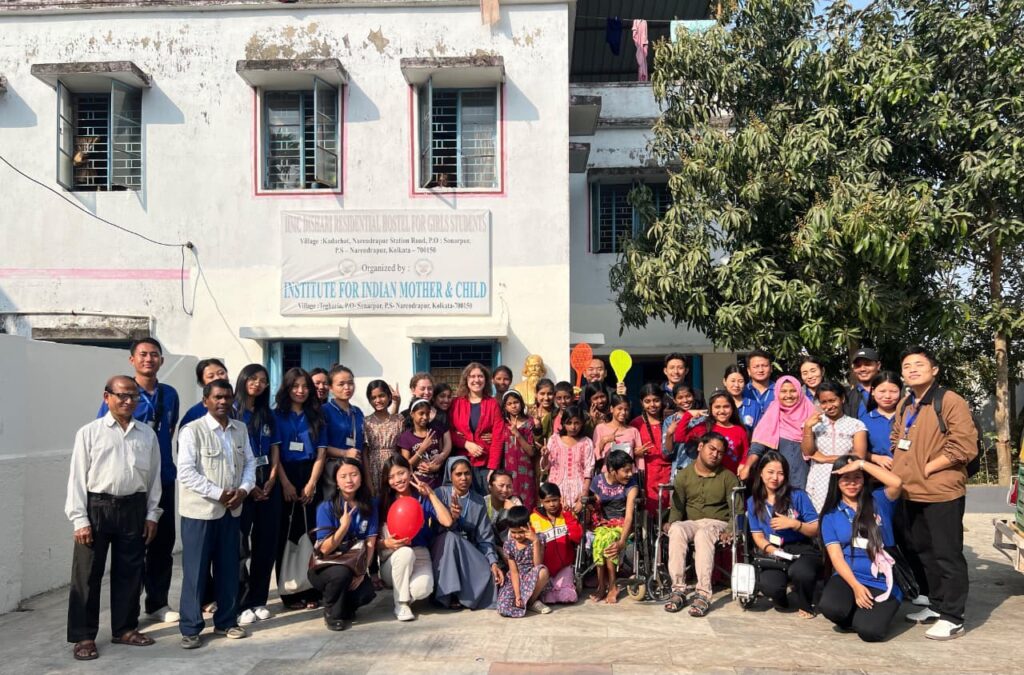
The MSW trainees specializing in Community Development (CD) undertook a study tour to Kolkata from 24th January to 4th February 2026. The visit enabled students to explore diverse cultures, heritage sites, and the varied functioning of NGOs across Kolkata. Students rendered services at Shanti Dan, Prem Dan, and Nirmal Hriday, organizations working with the destitute, orphans, and persons with disabilities, reflecting the core social work value of service. Institutional visits to the Child in Need Institute (CINI), Calcutta Rescue, and the Institute for Indian Mother and Child (IIMC) provided insights into child protection, community health, education, women’s empowerment, and livelihood initiatives. An interaction with Dr. Sujit Kumar Brahmochary, Founder and Director of IIMC, inspired trainees through his journey of establishing extensive healthcare and education services for underprivileged communities. The students also visited Mother Teresa’s House, the Victoria Memorial, the Indian Museum, Science City, and Eco Park, enhancing their cultural and historical understanding.
Similarly, the MSW trainees of Youth Development (YD) specialization successfully completed a study tour to Kolkata and Sikkim from 24th January to 6th February 2026. The tour provided exposure to youth-focused organizations and community initiatives. Students interacted with organizations such as Mother’s House, House of Hope, SEVA Kendra, Child in Need Institute (CINI), ADORE, Destiny Reflection, Prayasam, and the All Bengal Men’s Forum (ABMF), and also engaged with urban slum communities to understand grassroots realities. Visits to heritage sites including the Victoria Memorial and Eco Park, as well as exposure to Sikkim’s Changu Lake and Nathula Pass, enriched their understanding of youth development across diverse socio-cultural contexts.
The MSW trainees of Social Entrepreneurship Development (SED) specialization also undertook a study tour to Kolkata as part of their academic requirement. The tour aimed to provide practical exposure to the functioning, funding models, challenges, strategies, and success stories of organizations engaged in social entrepreneurship and community development. The trainees visited organizations such as Udayani Social Action Forum, Udayan Shalini Fellowship, Lifeline Foundation, Jayiyo Kristiyo Prochar Samity (JKPS), Prayasam, ADORE Volunteer Organization, Destiny Foundation, House of Hope, and the Mother Teresa House of the Missionaries of Charity. Through interactions with founders, staff, and beneficiaries, the trainees gained insights into organizational structures, financial sustainability, programme implementation, leadership, and ethical administration. They also visited places of historical and environmental significance including the Zoological Garden, Indian Museum, Eco Park, and the Victoria Memorial, broadening their cultural perspectives.
Overall, the study tours proved to be meaningful academic engagements that bridged theoretical knowledge with field realities. They strengthened trainees’ understanding of peacebuilding, community development, youth engagement, and social entrepreneurship, while reinforcing the professional values of teamwork, discipline, service, and social commitment. NEISSR continues to uphold practice-based education and field immersion as core components of its social work programmes, equipping students to become competent and compassionate professionals committed to social transformation.
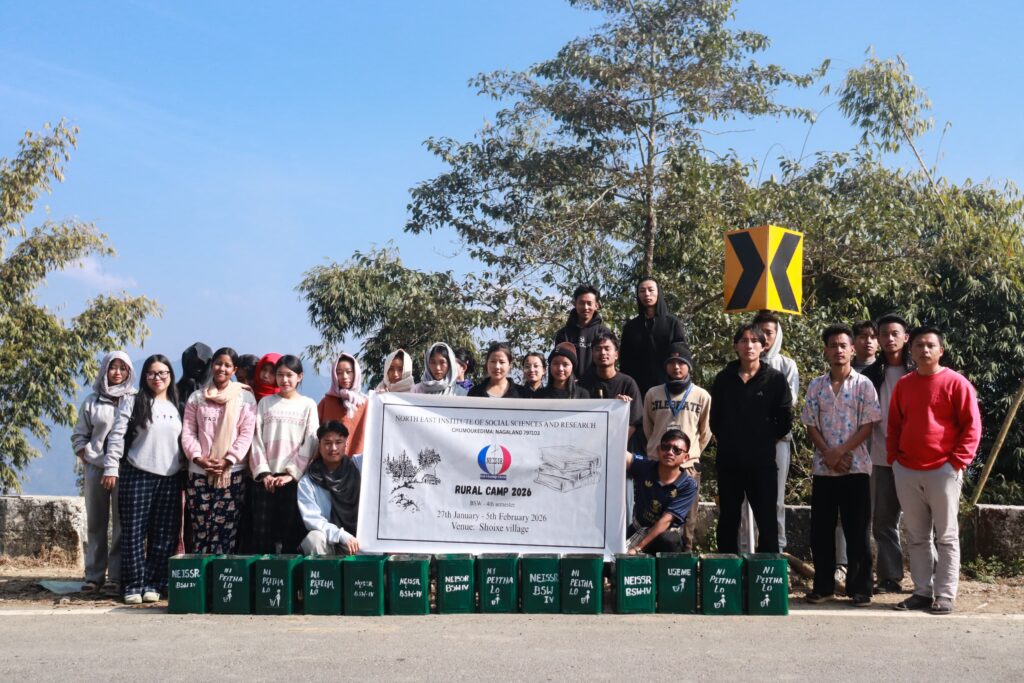
The fourth semester trainees of the Bachelor of Social Work (BSW) programme of the North East Institute of Social Sciences and Research (NEISSR), Chümoukedima, conducted a ten-day rural camp at Shoixe village under Sataka block, Zunheboto district, from January 27 to February 5, 2026.
The rural camp was organised as an integral component of the institute’s fieldwork and community engagement requirements, with the objective of providing trainees with experiential learning in rural development processes, participatory research methods and community organisation.
During the camp period, trainees undertook Participatory Rural Appraisal (PRA) exercises to understand the village profile, available resources and prevailing living conditions. The PRA activities included social mapping, seasonal mapping, resource mapping, matrix ranking and timeline exercises. Home visits were conducted to facilitate direct interaction with households and to obtain insights into the socio-economic conditions of the community. A socio-economic survey of selected households was also carried out as part of the academic requirements.
The trainees also conducted an awareness programme on drug addiction, highlighting its social, health and economic consequences and emphasising preventive measures and community responsibility in addressing substance abuse.
As part of community development initiatives, the trainees assisted villagers in clearing forest land. A cleanliness drive was undertaken in collaboration with the NSS Unit, NEISSR, during which dustbins were installed at selected locations in the village to promote sanitation and environmental awareness. A sports meet was organised during the camp, witnessing active participation from villagers and trainees. Picnic was also organised to promote peer bonding, teamwork and mental well-being among trainees.
On February 4, 2026, the trainees observed World Cancer Day. The camp concluded with a cultural programme themed “Celebrating Culture, Unity and Community”, which featured cultural performances, folklore presentations, a talk on the preservation of indigenous culture and special performances by trainees and community members. The rural camp enabled trainees to gain first-hand exposure to rural life, strengthen their understanding of community processes and apply social work methods in field settings.
The institute placed on record its appreciation to the Shoixe Village Council, Village Development Board, Church authorities, Youth Forum, Students’ Union and residents of Shoixe village for their cooperation and support in the successful conduct of the rural camp.
North East Institute of Social Sciences and Research (NEISSR), Peace Centre, 7th Mile, Chümoukedima, Nagaland, welcomed Bachelor of Social Work (BSW) and Master of Social Work (MSW) students on 21st January 2026 with a vision-setting address by Dr. Fr. C.P. Anto, Principal, titled “The Architect of Social Change: Mastering the 30 Essential Skills.” The address marked the beginning of the 3-day Orientation Programme and outlined NEISSR’s distinctive philosophy of skill-based, mission-driven social work education.
Addressing the students, Dr. Fr. C.P. Anto emphasized that entering the campus is not merely an admission into a college, but an entry into a mission-driven laboratory for social transformation. The institution reiterated its belief that a Social Work degree is not a certificate of what one has read, but a testament to the skills one masters and the lives one is prepared to uplift.
Highlighting the practitioner’s role in bridging the gap between theory and reality, social workers were described as “social architects” – professionals who employ high-level competencies to rebuild broken systems and respond to complex social challenges. In this context, NEISSR introduced its framework of 30 essential professional and life skills, clarifying that these skills are developed progressively throughout all semesters and are not confined to the orientation programme alone.
The importance of The Art of Engagement was stressed, with emphasis on counselling and empathetic listening as professional interventions rather than emotional responses. Students were oriented toward developing cultural competence and inclusivity to work effectively within the diverse social fabric of the North East. Emotional intelligence and stress management were highlighted as essential capacities that enable practitioners to support others without compromising their own well-being.
Recognizing social work as both an art and a science, NEISSR emphasized The Power of Analysis, including critical and analytical thinking, research writing, documentation, and evidence-based problem-solving. Students were encouraged to transform field experiences into knowledge that informs policy, strengthens practice, and ensures impactful decision-making during moments of social crisis.
A defining strength of NEISSR’s pedagogy – its focus on peacebuilding, dialogue, and reconciliation – was reiterated. Students are introduced to conflict resolution and mediation as core competencies that prepare them to function as peace leaders, capable of healing divisions and restoring trust within communities.
The address also highlighted operational excellence and management skills, including project planning, monitoring and evaluation, time management, self-discipline, digital literacy, networking, advocacy, and policy engagement. These competencies were presented as essential tools for moving beyond individual-level interventions toward sustainable, system-level social change.
In preparing students for professional life, emphasis was placed on communication, public speaking, ethical practice, and professional integrity. Through continuous fieldwork and community engagement, the 30 essential skills are forged through real-world practice, ensuring students graduate as competent and ethically grounded professionals.
NEISSR reaffirmed that society today does not merely need degree holders, but skilled practitioners with values, character, and technical competence. Students were encouraged to embrace the rigor of the academic journey, recognizing that each skill mastered becomes a tool for building a more just, peaceful, and sustainable society.
The Orientation Programme will continue with academic briefings, fieldwork orientation, institutional familiarization, and student engagement activities, laying a strong foundation for the comprehensive skill-development process embedded throughout the BSW and MSW programmes.
NEISSR warmly welcomes all to begin the journey of transforming themselves so that they may transform society.
Congratulations to Dr. Fr. C. P. Anto, Founder-Principal of NEISSR and Founder-Director of Peace Channel, for receiving the Best Researcher Award at the NAPSWI Annual Conference held at Centurion University, Bhubaneswar, Odisha from 6–8 November 2025.
His research presentation titled “Advancing Peace and Conflict Transformation Studies in Social Work in India: Academic Innovation and Community Engagement through the Peace Channel” was selected from among over 100 research presenters from 23 states, across 32 panels.
The National Association of Professional Social workers India (NAPSWI) has a net work of more than 1000 colleges and universities of Social Work across India. The award was presented by Prof. Sanjai Bhatt, President of NAPSWI, along with a certificate and cash prize.
Dear Fr. Anto, NEISSR and Peace Channel family are proud of your achievement. Your work continues to inspire many.
We extend our heartfelt congratulations to all the students of NSS volunteers who actively participated in the District Level Padayatra under the “Sardar @ 150 Unity March” Campaign held on 3rd November 2025, organized by the Mera Yuva Bharat under Ministry of Youth Affairs in collaboration with the District Administration, Chümoukedima.
Your enthusiastic involvement and commitment truly reflected the values of unity, leadership, and national spirit envisioned by Sardar Vallabhbhai Patel. You have not only represented our institution with pride but also contributed meaningfully towards fostering community participation and civic responsibility.
North East Institute of Social Sciences and Research (NEISSR) successfully organized a two-day IBM Skill Build Program on 31st October and 1st November 2025, aimed at enhancing students’ proficiency in digital technologies, Artificial Intelligence (AI), and employability skills. The program was conducted in collaboration with EduNet Foundation under IBM’s global digital learning initiative with Mr. Deepneel Majumdar, Subject Matter Expert and Manager at EduNet Foundation as the resource person.
On the first day, participants were introduced to the IBM Skills Build Platform – a free, globally recognized initiative by IBM designed to equip learners with cutting-edge skills in emerging technologies and professional development. Mr. Majumdar guided participants through six foundational courses: Exploring Data, Exploring Artificial Intelligence, Exploring Cloud Computing, Exploring Cyber Security, Exploring Quantum Computing, and Exploring Emerging Technologies.
Students successfully completed the first module, Exploring Data, gaining valuable insights into data fundamentals, data-driven decision-making, and the role of data in diverse industries. The interactive nature of the session inspired participants to continue exploring other modules on the platform to further enhance their digital literacy and employability potential.
The second day of the program began at 9:30 a.m. and centered on Artificial Intelligence and Employability Skills. Mr. Majumdar elaborated on various types of AI – Decision-making AI, Predictive AI, Generative AI, and Data-based AI – and explained their practical applications in contemporary digital ecosystems. His engaging teaching style enabled students to connect AI concepts with real-world uses in business, education, and technology.
The session also featured a segment on Resume Writing and Career Development, where Mr. Majumdar discussed key components of an effective resume, including personal information, educational background, professional experience, technical and soft skills, certifications, achievements, and a clear career objective. He emphasized the importance of crafting a concise and purposeful cover letter to accompany resumes, thereby strengthening candidates’ professional presentation and communication skills.
The program concluded with an interactive discussion between the resource person and participants, providing an opportunity for students to clarify concepts and share reflections. The event proved to be a valuable platform for fostering both technical expertise and employability competencies, preparing students for success in the digital workforce.
The program was held at BAM Hall, NEISSR, Chümoukedima, and was chaired by Ms. Sani Koshia. The invocation was led by Mr. Mhasileto, while Dr. Lily Sangpui, Assistant Professor, NEISSR, introduced and felicitated the resource person, acknowledging his contributions to academia and the IT industry.
52 students from NEISSR actively participated in the National Red Run 3.0 held at Agri Expo, 4th Mile Chumoukedima. Their enthusiastic involvement exemplified the institute’s commitment to promoting health awareness, social responsibility, and community engagement.
Heartfelt congratulations to all the participants for representing NEISSR with great spirit and dedication. Your participation has once again brought pride and recognition to our institute.
North East Institute of Social Sciences and Research (NEISSR) inaugurated its 11th Annual Sports Meet 2025 on 27th October 2025 at BAM Hall, Chümoukedima, under the theme “Strength in Unity, Power in Play.” The event was graced by Shri. Tenyebinlo Himb, Press Secretary to the Member of Parliament, Rajya Sabha, Nagaland, as the Special Guest.
In his address, Shri. Tenyebinlo Himb emphasized the importance of self-reflection and personal responsibility, urging the students to take initiative in bringing about positive change instead of attributing societal challenges to leaders or elders. He encouraged the youth to pursue their goals with sincerity, perseverance, and humility, stating that true success is not determined by wealth or appearance but by integrity, character, and service to society.
Highlighting his personal experiences, he stressed that education is a journey and not a race, and that success, like a tree, takes time to grow firm and strong. He further emphasized the values of unity, friendship, and the dignity of labour, reminding students to remain grounded, support one another, and ensure that their actions reflect their words.
The inaugural session was chaired by Ms. Bilu Lohe, Finance Secretary SCSC, with the Invocation led by Mr. Awa Khing EU President NEISSR, and the Keynote Address delivered by Ms. Lilo Chishi, Games and Sports Secretary, SCSC. A special number was presented by Mr. Zipise, while the Vote of Thanks was proposed by Ms. Vishili Sakhamo, Cultural Secretary, SCSC. The programme concluded with a Benediction pronounced by Rev. Fr. G. L. Khing, Vice Principal and Administrator, NEISSR. The event will conclude on 29th October 2025 with the closing ceremony and prize distribution.