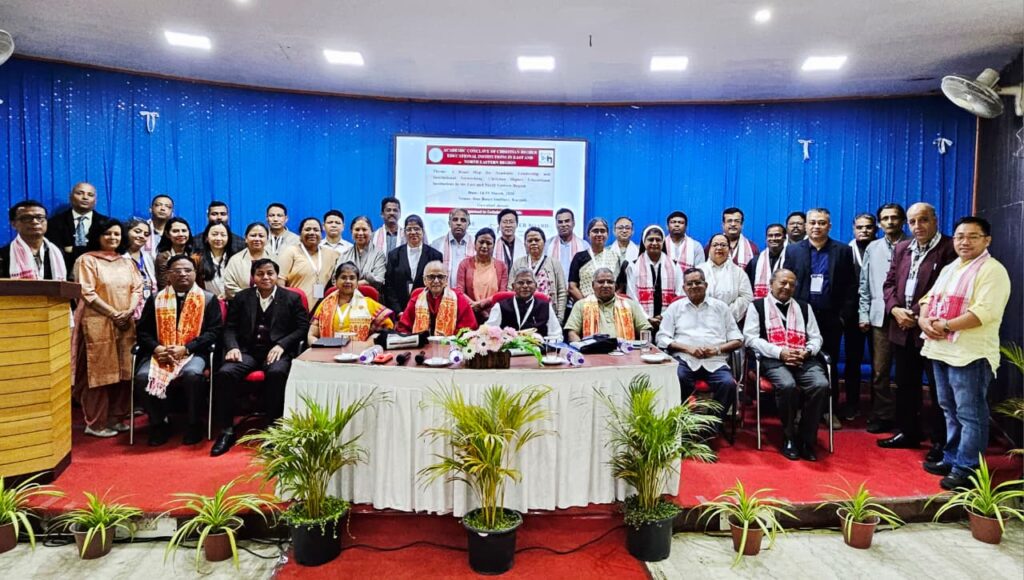
In a historic and unprecedented initiative, Christian Higher Educational Institutions from the East and North East Region of India came together for the first time under the joint banner of the All India Association of Christian Higher Education (AIACHE) and the Xavier Board of Higher Education in India. The two-day Academic Conclave, held on 14–15 March 2026 at Don Bosco Institute, Karguli, Guwahati, marked a significant milestone in fostering academic leadership, institutional networking, and mission-driven education in the region.
The conclave, themed “A Road Map for Academic Leadership and Institutional Networking: Christian Higher Educational Institutions in the East and North East Region,” brought together 40 participants representing 19 institutions. It created a vibrant platform for dialogue, collaboration, and shared vision among educators committed to academic excellence, social responsibility, and nation-building.
The inaugural session, moderated by Sr. Janet, began with a prayer by Most Rev. Thomas Menamparampil, SDB, Archbishop Emeritus of Guwahati, who invoked God’s blessings and called for responsible democratic participation, critical thinking, and value-based leadership among youth. The dignitaries present included Fr. Dr. X. Vedam, SJ (Secretary, AIACHE), Fr. Dr. C. P. Anto (Principal, NEISSR), Dr. Sr. Nirmala (General Secretary, AIACHE), Dr. Madhumanjari Mondal (Principal, Scottish Church College and President, AIACHE Eastern & North Eastern Region), and Rev. Dr. Fr. Paul Pudussery (Secretary, Education Commission, North East Region).
Delivering the welcome address, Dr. Madhumanjari Mondal described the conclave as a first-of-its-kind historic gathering aimed at sharing best practices while openly addressing institutional challenges. Fr. Dr. C. P. Anto the president Xavier Board East and North East region and Principal NEISSR, in his thematic introduction, emphasized the need for a context-sensitive and value-based roadmap for higher education, highlighting youth empowerment, promotion of indigenous knowledge systems, peacebuilding initiatives, and the importance of listening to marginalized communities of the North East.
Fr. Dr. X. Vedam, SJ, in his address, underscored the untapped collective potential of over 1000 Christian higher educational institutions in India and called for stronger collaboration to influence educational policy and practice. He emphasized culturally rooted education, critical thinking, and the need for teachers to act as change-makers. Rev. Dr. Fr. Paul Pudussery, in his special address, highlighted the transformative impact of Artificial Intelligence while stressing the responsibility of educators to safeguard human dignity, concluding with the powerful insight that while AI shapes technology, educators shape humanity.
The keynote address on “Academic Leadership in a Changing India: Faith, Excellence and Responsibility” was delivered by Rev. Fr. V. M. Thomas Vattathara, SDB, Founder and Advisor of Don Bosco Institute. He presented a compelling framework for institutional transformation through the stages of Inform, Reform, Form, Perform, and Transform, while also addressing contemporary challenges such as globalization, employability, technological disruption, and the need for visionary leadership rooted in values.
The plenary and technical sessions featured a distinguished line-up of speakers. Mr. John Peter emphasized accountability, academic planning, and the need to move beyond superficial accreditation practices. Mr. Kishor Das highlighted youth as peacebuilders through peer mediation and the establishment of Peace Centres in higher educational institutions.
Prof. Amitab Roy (St. Xavier’s College, Kolkata) spoke on strengthening academia–industry collaboration through joint research, innovation ecosystems, and industry engagement. Fr. Varghese (Rajagiri School of Engineering and Technology, Kerala) addressed digital transformation and introduced the concept of AI-integrated learning models. Prof. Alok John (Patna Women’s College) emphasized the critical role of Research and Development Cells in building institutional research culture aligned with national and global priorities.
Sr. Dr. Sheela Paul presented on student-centric curriculum design, advocating experiential and participatory learning approaches, while Dr. Samrat Bhattacharjee highlighted entrepreneurship, innovation, and incubation initiatives that foster practical learning and student-led enterprise.
The second day began with a special lecture by Dr. S. P. Singh (St. John’s College, Agra), who reflected on Christian higher education as a space for dialogue, peacebuilding, and social cohesion in a fragmented world. He emphasized reconciliation, dignity, and the role of education in fostering compassionate and critically engaged citizens. A recap of the previous day’s proceedings was presented by Dr. Asish Malhotra (Union Christian College, Shillong).
Sessions on collaboration and research were led by Fr. Dr. Babu Joseph (Salesian College, Siliguri), who shared institutional experiences and challenges, and Dr. Gayreen Lyngdoh (Synod College, Shillong), who emphasized the importance of faculty and student exchange programmes for knowledge production and academic enrichment.
In the focused round table, Fr. Dr. Jose Palely Devassy, Vice Chancellor of Assam Don Bosco University, highlighted the integration of academic excellence with Gospel values in light of NEP 2020, emphasizing holistic formation, multidisciplinary approaches, and ethical leadership.
The concluding panel discussion featured Fr. Dr. X. Vedam, Fr. Dr. C. P. Anto, Dr. Rudolph Manih, Dr. Madhumanjari Mondal, and Dr. John Peter, who deliberated on key regional academic priorities, leadership models, and strategies for strengthening institutional collaboration.
A major highlight of the conclave was the formal adoption of the “East and North East Region Declaration on Academic Leadership and Institutional Networking.” The declaration provides a clear and collective roadmap for the future of Christian higher education in the region, emphasizing:
* Visionary Academic Leadership rooted in ethical governance, excellence, and holistic human development inspired by Gospel values.
* Mission-Driven Academic Excellence aligned with NEP 2020, NAAC, and NIRF while preserving Christian identity and value-based education.
* Institutional Networking and Collaboration through faculty and student exchange, joint research, shared resources, and sustained academic partnerships.
* Youth Leadership for Peace and Social Transformation by empowering young people as peacebuilders through dialogue, diversity, and reconciliation initiatives.
* Research, Innovation, and Social Engagement addressing regional needs, promoting sustainability, and encouraging emerging fields of knowledge.
* Faculty Formation and Capacity Building through continuous professional development, research training, and leadership formation. The declaration was formally read by BarnicRajianlungGangmei, Assistant Professor at NEISSR, Nagaland.
The valedictory session featured reflections by Fr. Dr. X. Vedam, who emphasized the need to translate the outcomes of the conclave into sustained institutional action. Fr. Cletus Sebastian, Executive Director of Don Bosco Institute, expressed gratitude for the successful organization of the programme. The vote of thanks was delivered by Sr. Joyti, who acknowledged the contributions of AIACHE, the Xavier Board, all speakers, moderators, and participants, as well as the hospitality of the host institution.
This first-ever regional convergence marks a new chapter in the journey of Christian higher education in the East and North East Region. It signals a strong collective commitment to collaboration, innovation, peacebuilding, and transformative leadership, ensuring that these institutions continue to serve as centres of excellence, values, and social transformation.
Issued by:
Organizing Committee
AIACHE & Xavier Board of Higher Education in India. Mr. Barnic 8787804198